Showing posts with label Core Maths. Show all posts

Sunday, 28 June 2015

Finding the inverse of a function

A function is  a special mapping where every element from set A (the domain) is mapped exactly to one element in set B (the range).

Domain refers to the x values that the function occupies, and range referring to the y values. For example: A function of 1/x does not have any values of x=0 or y=0 because these are the asymptotes of the equation.

Therefore... for every value of A to map to set B, the domain and range must specify this i.e:
 Domain:   x ∈ R, x ≠0
 Range:       y ∈ R, y ≠0


 Now every element from set A maps to elements in set B and the equation f(x) = 1/x {x ∈ R, x ≠0} and is now a function.

It is regarded as a one-to-one function because every element of the range comes exactly from one element in the domain.

Finding the inverse of a function:

The example function will be: 2x²-7

1.Set the function equal to y:


y=2x²-7

2.Rearrange to make x the subject:

y=2x²-7
y+7=2x²
0.5(y+7)=x²
x=√(0.5(y+7))

3.Replace (x=) with (f-1(x)=) and replace (y) with (x)

x=√(0.5(y+7))
f-1(x)=√(0.5(y+7))
f-1(x)=√(0.5(x+7))

The inverse of a function graphically, is literally just f(x) reflected in the line y=x.

For example:
https://en.wikipedia.org/wiki/Inverse_function#/media/File:Inverse_Function_Graph.png
"https://en.wikipedia.org/wiki/Inverse_function#/media/File:Inverse_Function_Graph.png"

As shown above, the function just gets reflected in the line y=x to give the inverse function.

Thursday, 19 March 2015

Checking Validity of Functions and Inverse Functions

Sometimes it can be hard to tell whether or not a graph or equation is a valid function or not. Here are some simple steps to checking this:

Horizontal line test: If a straight line can be drawn horizontally that crosses the graph in two places, then this function is called a many to one function. This is only true if a values of x are plotted. However, when finding the inverse of this function, the graph will be reflected in y=x and will no longer abide by the Horizontal line test, but the Vertical line test.

Vertical Line test: If a straight, vertical line can be drawn that crosses the graph in two places, then this is 'one to many' which is not a function. 

1) Vertical line test true = not a function.
2) Horizontal line test true = many to one function
    Horizontal line test true = inverse will not be a function.

Friday, 6 March 2015

Long Division VS Remainder Theorem

Both methods may be used to divide polynomials by a factor such as (x-3), however take different steps in reaching the end goal.


Long Division


As shown, the factor (x-3) is multiplied by a term to create a new expression that can be subtracted from the original polynomial. This is repeated until the polynomial reaches 0 in which case there is no remainder, or it cannot be divided further, in which case there is a remainder.
The terms are then collected and the remainder is stated as above: 29/(x-3) where the remainder is divided by the divisor.

The Remainder Theorem

This method in my opinion takes longer. The idea is that a polynomial (Ax^3 + Bx^2 + Cx + D) is created and using substitution, these values of ABCD can be calculated. First assume there is a remainder i.e. +D.
We then let x =3. This allows us to work out the value of D.
Then we let x =0. This allows us to work out the value of C.
We then compare coefficients i.e. the coefficient (LHS) of x^3 is 1. Therefore the coefficients of all the x^3's on the RHS must also equal to 1. Therefore A=1.
With x^2 LHS equals 1. Therefore all of the x^2 terms i.e. -3Ax^2 + Bx^2 must also equal 1. This can be used to work out the remaining values of ABCD and the remainder stated, divided by the divisor i.e. 29/(x-3).

Sunday, 18 January 2015

Manipulation of Logarithms

With Logarithms, there aren't that many ways that they can manipulated. Here are the 6 different rules that will allow you to manipulate most equations:

Where 'b' is the base
Where 'a' is the part in the brackets

1)  The log can be manipulated  to remove the log if it is given a value: here such as 'c'.

Logb(a)=z       Then b^z=a

2)  The Coefficient of the Log can be moved to the power:

Y Logb(a) = Logb(a)^Y

3)  The Log of (ac) can be written as two different Logs; where they are split by an addition sign.

Logb(as) = Logb(a) + Logb(s)

4) The Division of the Log can be changed to a minus sign, keeping the base of the log the same.

Logb(a/s) = Logb(a) - Logb(s)

5) Any Log with the base the same as the part in the brackets will = 1. This is because anything to the power of 1 will equal itself. 

Logb(b) = 1

6) When changing the base of the Log: Rewrite the same thing but change the base to whatever you want; then divide this by Log with the new base, with in brackets the old base.

Where c is the new base

Logb(a) = Logc(a)/Logc(b)


Thursday, 8 January 2015

Trigonometric Identities

Trigonometric Identities can be used to simplify an equation before solving it. They can be used for any values of x.

IDENTITIES:

1)      Tan x = Sin x / Cos x

2)      Sin^2 x + Cos^2 x = 1

Using these two identities; equations will be able to be manipulated to allow you so simplify / solve them.

For Quadratic Equations always remember:

1) Try and make the equation only (sin^2 x / sin x) or (cos^2 x / cos x). Eliminate all other terms using the identities above.

2) An equation can only be solved if    sin x = k    or    cos x = k     if     1 ≥  k  ≥ -1.
Solutions to     tan x = k     exist for ALL VALUES of k.


Example 1:

"Show that    Tan x  +  (1/Tan x)  can be written in the form (1/Cos x Sin x)".

Tan x  +  (1/Tan x)
This is the original starting point given in the question.

(Sin x / Cos x) + (Cos x / Sin x)
 Tan x = (Sin x / Cos x)      and    (1/ Tan x) =  (Cos x / Sin x)

(Sin^2 x + Cos^2 x/Cos x Sin x)
Cross multiply and make the two fractions into one.

(1/Cos x Sin x)
Sin^2 x + Cos^2 x = 1    Therefore the top part of the bracket becomes one and the denominator stays the same.


Example 2:

"Show that    5cos x = 1 + 2Sin^2 x    can be written in the form 2cos^2 x + 5Cos x -3 = 0".

5cos x = 1 + 2Sin^2 x
This is the original starting point given in the question.

5cos x = 1 + 2(1-Cos^2 x)
Sin^2 x + Cos^2 x = 1         REARRANGED =        Sin^2 x = 1 - Cos^2 x 
Sin^2 x   has been substituted for     1 - Cos^2 x.

5cos x = 1 + 2 - 2 Cos^2 x
The brackets have been expanded from 2(1-Cos^2 x) to 2 - 2 Cos^2 x

2 Cos^2 x + 5Cos x -3 = 0
The terms have been grouped and formatted as positioned in the question.


Monday, 22 December 2014

Transformation of Graphs

Transformation of Graphs, is actually much easier than you maybe would have thought. Here are the condensed notes that will let you quickly learn how to change the shape/position of a graph.

F(x) means just a function of x. For the purpose of this post, the F(x) will be x^2. This is just a simple parabola going through 0.

RULE 1
Anything outside of the brackets will affect the position of the graph in the y axis.
E.g. F(x) +1 will cause the graph to move 1 y unit upwards.
F(x) -4 will cause the graph to move 4 y units downwards.

RULE 2
Anything inside of the brackets will cause movement in the x axis.
If it is a + or - e.g. F(x+1) will be movement in the x axis -1 units.
F(x-5) will cause the graph to move 5 units to the right in the x axis.

NOTE - Anything inside of the bracket will do the opposite of what you think it would do. So +1  will move x -1 and, -2 will move x +2. 

RULE 3
Coefficients  of x will cause a stretch in the x axis.
E.g F(2x) will cause a stretch of 1/2 in the x axis.
F(1/4x) will cause a stretch of 4 in the x axis.

Careful: Let the coefficient of x be C. The stretch of the x coordinates will be equal to 1/C.

RULE 4
Any coefficient of the function will cause a stretch in the y axis.
E.g 2F(x) will cause a stretch in the y axis of 2; Causing all y values to be doubled.
1/2F(x) will cause a stretch in the y axis of 1/2; Causing all the y values to be halved.

Hint: You can treat the F(x) as y. This makes it easier to interpret when transforming the graph.
E.g 4F(x) means 4y which is 4 lots of the y values which is a stretch in the y axis of 4.


Tuesday, 25 November 2014

How to use Differentiation to find the gradient at a point

Before reading this post, I would strongly recommend looking at my other post of how to differentiate if you do not know how to do so already.

Assuming you know how to differentiate equations; lets begin.

differentiation tricks
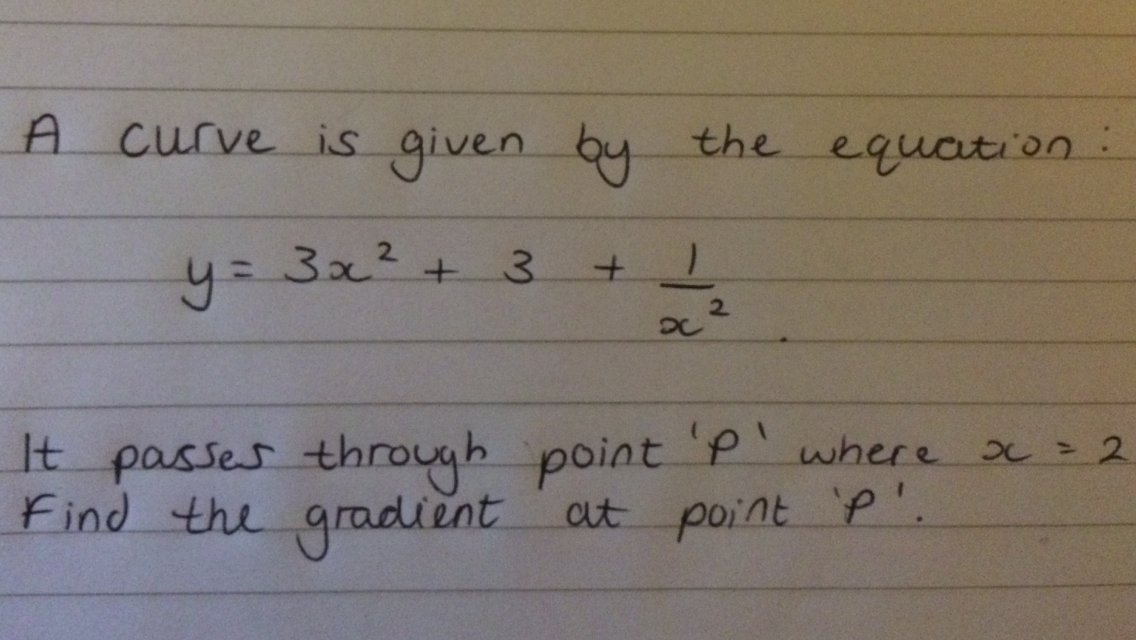
Here is an example of a common question that involves dy/dx:


First of all breaking down the question it is basically asking you to differentiate the equation, then substitute the value of x to find the gradient at point P.


This is simply done and using simple algebra and substitution we can derive that the gradient has a value of 11.


Very Easy...


We could also be asked this question:


The steps to approaching this would be to:

1) Use the gradient we have already found to find the gradient of the normal.

2) Use substitution to find the value of y

3) Use the new values to find the value of c and complete the equation.


The image below shows using -1/m to find the perpendicular gradient.

Then we use the original formulae of the curve to find the value of y, as shown here -------->


 We then substitute the values of x and y into our new equation in the form of:

y=mx + c

We then find that c = 15.48.

We now have the equation as shown :)


Monday, 17 November 2014

How to Differentiate Equations

Differentiation may seem very confusing at first but it is actually very simple and easy as long as you follow these short instructions.

Differentiation is used to find the gradient in most cases of a graph at a specific point. This is done by finding the dy/dx and the substituting into the new equation an x value to find the gradient at that point.
differentiation
Here are the short tips to make differentiation easy:


1) Make the equation as simple as you can make it. 


This is done by making the coefficients of x nice numbers and the same with the powers of x. This requires indices rules. For example:

simple steps to differentiation


As you can see when given an equation you want to make it as simple as possible. This will make things A LOT easier.

Here is an example of an equation of a line that becomes much more simplified:


Easy steps to differentiation

2) Multiply the coefficient of x by the power (coefficient means the number before the x!)

This is quite a straightforward step:

In this step you do not want to change the value of  anything except the coefficient of x.
easy differentiation steps

3) Minus 1 from the power!

This can be done as shown:


And that's it! This is an example of an actual question with all the steps:

examples of how to differentiate equations

1)  Original equation


2)  Simplifying values of x


3)  Multiplying the power by the coefficient

Note - anything to the power of 0 = 1

4)  Minus 1 from the powers of x

5)  Easy peasy :)